The Real Cost of Industrial Water | Excel Water
David Fuller - 16th Jun 2026
What does water actually cost your site? Beyond the monthly bill, the real figure can include wastewater and trade effluent charges, pumping energy, salt, chemicals, membranes, cartridges, resin, service visits, reactive callouts, downtime, quality failures, storage limitations, emergency deliveries and lost production. This article helps you see the complete picture.
Water is Becoming a Strategic Business Issue
The current pressure around the UK water sector is hard to ignore. Thames Water’s financial difficulties have kept water infrastructure, investment and public trust firmly in the news. At the same time, dry-weather planning continues to receive national attention — the Environment Agency has confirmed that the National Drought Group is actively assessing drought planning, demand reduction and supply resilience.
For industrial sites, this does not mean there is an immediate crisis at every location. But it does mean water resilience deserves proper attention.
If a manufacturing process relies on water for cleaning, rinsing, cooling, steam raising, product quality, chemical dilution, laboratory use, demineralised water, wastewater handling or general process stability, then water is not just a background service. It is part of production continuity.
The best question is not simply: “How much is our water bill?”
The better question is: “What is water really costing this site?”
The Water Bill Is Only the Starting Point
The visible water bill is often only one part of the cost. A full review should consider all of the following — many of which can be split across different budgets, making them easy to underestimate when viewed in isolation.
Supply & Discharge
- Mains water supply
- Wastewater & sewerage charges
- Trade effluent costs
- Surface water & drainage charges
Consumables & Treatment
- Salt usage
- Chemical usage
- Cartridge, media & resin replacement
- Membrane replacement
Operations & Energy
- Electricity for pumping & treatment
- Water lost through reject or backwash
- IBC demineralised water deliveries
- Internal handling & storage
Downtime & Risk
- Service & maintenance visits
- Reactive callouts
- Production downtime
- Quality failures & compliance risk
Facilities may see the water bill. Engineering may see the maintenance issues. Production may see the downtime. Finance may see the consumables. Environmental teams may see the discharge targets. But the site pays for all of it.
Wastewater and Discharge Can Change the Calculation
For some sites, the cost of water is not only about what comes in. It is also about what goes out. Wastewater volume, trade effluent strength, discharge limits and treatment requirements can all have a major impact on operating cost. A site may focus heavily on reducing incoming water use, while overlooking the cost of sending treated water, process water or contaminated water to drain.
This is particularly important for businesses using reverse osmosis, nanofiltration, demineralisation, softening or other treatment processes. RO reject, softener regeneration, filter backwash, cleaning cycles and rinse water can all contribute to wastewater volume.
A note on recovery rate: The aim is not always to chase the highest possible recovery. Higher recovery can increase scaling risk, energy use, chemical demand, cleaning frequency and maintenance complexity. Sometimes a stable, lower-recovery system gives better lifetime value than one that pushes too hard and needs constant intervention. The right answer depends on the site — but wastewater and discharge should always be part of the calculation.
Energy Cost Is Part of Water Treatment Cost
Industrial water treatment does not operate in isolation from energy. Pumps, pressure vessels, reverse osmosis systems, nanofiltration systems, recirculation loops, UV units, dosing systems and control panels all require power. In membrane treatment, energy can become a particularly important part of the operating model.
A well-designed and well-maintained system can reduce waste, improve reliability, protect equipment, reduce consumables and support production quality. But energy should be included in any design and commercial review. Useful questions include:
- Is the system correctly sized for current production?
- Are pumps operating efficiently?
- Is membrane fouling increasing pressure and energy demand?
- Is poor pretreatment shortening membrane life?
- Is the system producing more treated water than the site needs?
- Is treated water being sent to drain unnecessarily?
- Would improved storage reduce peak demand?
- Would water reuse or recovery reduce incoming water and wastewater costs enough to justify additional energy use?
Water treatment is not just a water decision. It is also an energy, maintenance, production and resilience decision.
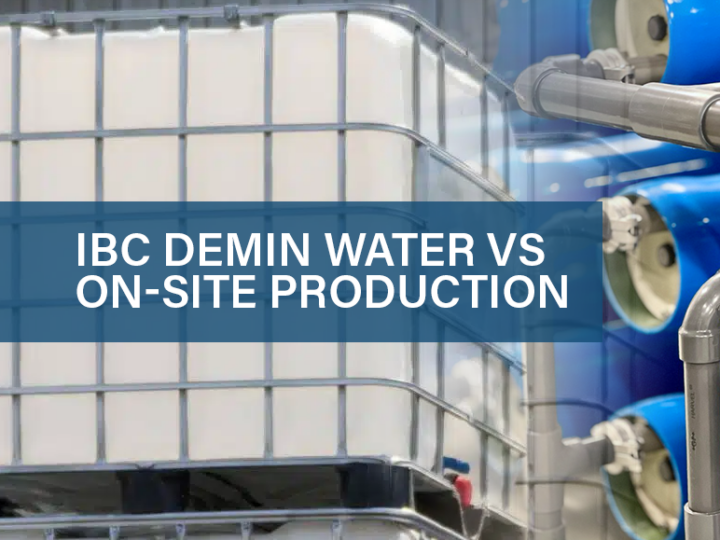
IBC Demin Water: Convenient, But Not Always Economical
Many businesses buy demineralised or deionised water in IBCs because it is simple. There is no plant to install, no resin or membranes to manage, no pretreatment to consider and no service schedule to maintain. For low-volume, irregular or temporary use, that can be the right decision.
But once IBC water becomes part of normal production, the true cost deserves a closer look. A 1,000-litre IBC is only one cubic metre of water — and once delivery, handling, storage, emergency orders, empty-container logistics and quality checks are included, the delivered cost per usable litre can rise quickly.
Factors That Increase IBC Cost
- Delivery charges on top of IBC price
- Storage space and internal handling
- Emergency or top-up orders
- Empty container management
- Quality checks and supplier dependency
- Risk of running out during production
On-Site Generation Review Should Include
- Annual IBC spend (total, not per unit)
- Water quality required at point of use
- Capital cost of RO / DI / demin plant
- Servicing and consumables
- Payback period
- Resilience and supply continuity value
Buying IBC demin water is not wrong. But regular IBC use should always trigger a proper make-versus-buy review.
Maintenance Is Part of Water Efficiency
When cost pressure rises, maintenance is often one of the first areas businesses look to delay. With water treatment, that can be a false saving. A poorly maintained system may still appear to be working while quietly increasing operating costs.
Signs a System May Be Costing More Than It Should
- A softener regenerating too often can waste salt and water
- Exhausted resin can allow water quality to drift
- Blocked filters can reduce flow and increase pressure issues
- Fouled RO membranes can reduce output and increase energy demand
- Poor pretreatment can shorten membrane life significantly
- UV systems can lose effectiveness if lamps, sleeves or pre-filtration are neglected
- Conductivity instruments and control systems can become unreliable if not checked
- Small leaks or drain-to-waste issues can become expensive over time
A service visit, media change, membrane clean, resin replacement, instrument check or minor remedial upgrade may deliver better value than allowing a system to deteriorate until production is affected. See also our guides to water softener troubleshooting and RO system performance.
Water efficiency is not always a new capital project. Sometimes it starts with making the existing system perform properly.
Water Efficiency Incentives Are Starting to Appear
The direction of travel is also changing at a regulatory level. Ofwat has highlighted charging trials — including an Anglian Water trial from April 2026 for some non-household customers — designed to encourage investment in on-site water efficiency measures. Business water charges are also changing through the PR24 period, with 2026/27 charges now feeding through from wholesalers and retailers.
For high-use sites, this makes water data more valuable. Businesses that understand their water use, treatment performance, wastewater profile, peak demand, storage capacity and process dependency will be better placed to respond to future changes in cost, availability and regulation.
Water efficiency is increasingly being treated as something businesses can actively influence — not just something water companies talk about. For manufacturers, the message is clear: water should be reviewed as part of the wider cost base, not as an isolated utility.
What Manufacturers Should Review
A practical industrial water review should include more than the monthly bill. The following ten questions provide a useful starting framework for any site that wants to understand what water is really costing the business.
Question 1
Where is water used?
Break usage down by process, cleaning, rinsing, cooling, boiler feed, domestic use, laboratory use, product contact and wastewater-generating activities.
Question 2
What quality is required?
Not every process needs softened, RO, demineralised or UV-treated water. Over-treating water can waste money, energy, chemicals and capacity.
Question 3
What is being sent to drain?
Review RO reject, softener regeneration, filter backwash, rinse water, leaks, drain-to-waste loops and cleaning cycles.
Question 4
What does wastewater cost?
Include wastewater charges, trade effluent, discharge restrictions and any treatment requirements — not just incoming supply.
Question 5
Is the system still correctly sized?
Production volumes, operating hours, product lines and cleaning regimes change. A system that was right five years ago may not be right today.
Question 6
Are consumables increasing?
Salt, chemicals, cartridges, membranes, resin and media consumption can reveal whether the system is operating efficiently or beginning to struggle.
Question 7
Is maintenance planned or reactive?
Reactive maintenance usually costs more than planned support, especially once production disruption is factored in. See our service and maintenance options.
Question 8
Is water resilience understood?
How long could the site operate if water supply, pressure or quality changed? Is there storage, backup or treatment flexibility in place?
Question 9
Could water be reused or recovered?
Some water streams may be suitable for reuse or recovery after appropriate treatment. Others may not. The opportunity needs technical review specific to the site.
Question 10
Is buying water still the best option?
If the site regularly buys IBC demineralised or deionised water, it may be time to compare delivered supply against on-site production on a total-cost basis.
The Commercial Opportunity
The real cost of industrial water is bigger than the water bill because water touches so many parts of a manufacturing site. It affects production, quality, cleaning, compliance, maintenance, energy use, wastewater, resilience and operating cost.
For some businesses, the opportunity may be a full water reuse or recovery project. For others, it may be a service review, softener optimisation, RO performance check, resin change, storage review, borehole assessment, IBC make-versus-buy calculation or better monitoring.
The right answer depends on the site. But the starting point is the same: understand what water is really costing the business.
Talk to Excel Water About Your Site
At Excel Water, we design, build, service and support bespoke commercial and industrial water treatment systems — including reverse osmosis, nanofiltration, demineralisation, water softening, filtration, UV disinfection, borehole treatment and water reuse solutions. If you are reviewing your site’s water use, treatment costs or process resilience, we can help identify where water is costing more than it should.
Sources & Further Reading
- UK Government / Environment Agency — dry weather information and National Drought Group updates
- Ofwat — PR24 determination, charging trials and water efficiency incentives
- Business Stream / Water Plus — wholesale price changes for 2026/27
- Reuters — Thames Water rescue plan and special administration risk
- Excel Water — water resilience, water efficiency and high-recovery treatment articles
Back to Latest News